
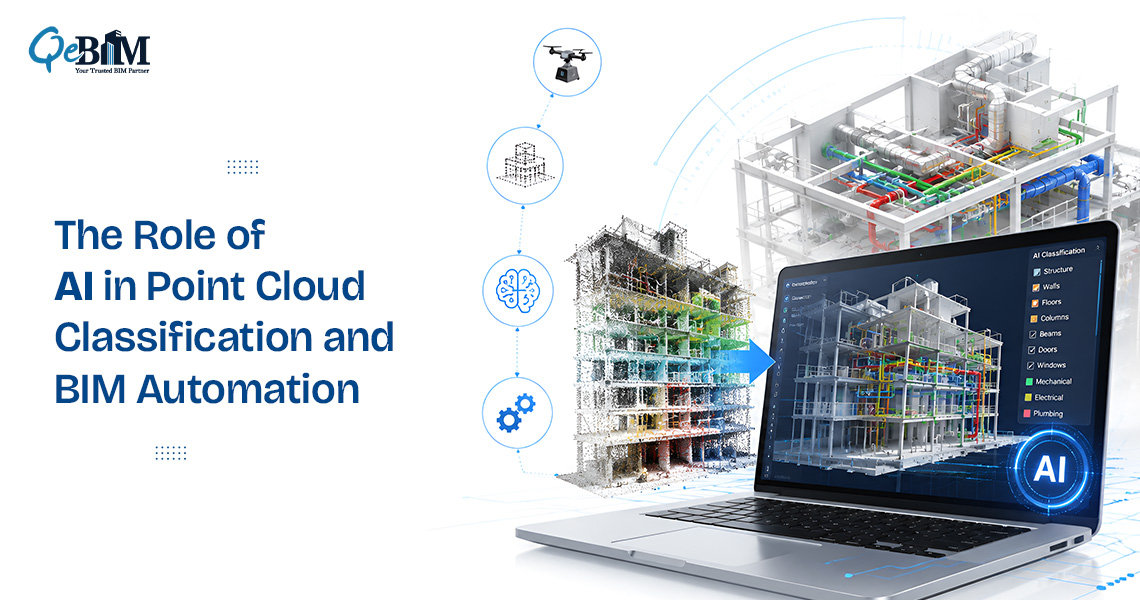
Point clouds is an important medium of reality-capture data for the AEC industry. Generated through the terrestrial laser scanning, mobile LiDAR, photogrammetry or other reality-capture technologies, they provide millions or even billions of spatial points representing existing buildings and infrastructures. However, raw point clouds contains geometry without sufficient semantic meaning. A point may represent a wall, ceiling, pipe, beam, furniture or equipment, but the dataset itself does not inherently identify what that point represents.
This is where AI is changing the point cloud classification. By applying machine learning and deep learning techniques, point cloud data can increasingly be analyzed, segmented and assigned meaningful categories before it moves into downstream modeling workflows.
Recent research shows growing adoption of AI for point cloud segmentation and Scan-to-BIM, with methods such as PointNet++, convolutional neural networks, graph-based approaches and transformer-based architectures being investigated for automated 3D understanding.
What Is Point Cloud Classification?
Point cloud classification is the process of assigning semantic labels to points or groups of points based on their geometric, spatial and sometimes visual characteristics.
For example, an AI model may classify points as:
- Walls
- Floors
- Ceilings
- Doors and windows
- Columns and beams
- Pipes and ducts
- Cable trays
- Mechanical equipment
- Furniture
- Structural components
Classification is closely related to semantic segmentation. Classification generally identifies the category of an object or point set, while semantic segmentation assigns labels at the individual-point level or across spatial regions. In Scan-to-BIM workflows, semantic segmentation is particularly important because it helps to transform the unstructured scan data into organized information that can support BIM modeling.
Why Traditional Classification Is Challenging?
Manual point cloud classification requires technicians to inspect the dense datasets and identify building elements based on geometry, location and context. Large projects can contain enormous volumes of data, making this process time-consuming and susceptible to inconsistencies.
Point clouds also present technical challenges for AI systems. Unlike images, they are irregular and unordered rather than arranged in a regular 2D grid. They can contain noise, occlusions, missing surfaces, variable point density, reflective surfaces and overlapping building components. Research reviews identify these characteristics as major challenges for deep-learning-based point cloud processing.
How AI Classifies Point Clouds?
AI-based classification typically begins with training a model using point cloud datasets in which points or objects have already been assigned semantic labels.
The model learns patterns from features such as:
Geometry: Point distribution, surface shape, curvature and local structure can help distinguish a wall from a pipe or a beam.
Spatial relationships: The location of an element relative to surrounding geometry provides contextual information. For example, a horizontal surface near the bottom of a room is more likely to represent a floor than a ceiling.
Surface characteristics: Normals, density, intensity and other scan-derived attributes can provide additional classification signals.
Color and imagery: RGB information from scanners or integrated imagery can supplement geometric information, particularly where different materials or surfaces have visually distinct characteristics.
Deep learning models then learn relationships between these features rather than relying entirely on manually defined rules.
Role of Deep Learning
Several deep learning architectures have been developed specifically to process the 3D point clouds. Point-based networks such as PointNet and PointNet++ directly process individual points and their local neighborhoods. PointNet++ extends this concept by learning hierarchical features from increasingly larger spatial regions.
Other approaches use voxel representations, sparse convolutional networks, graph-based techniques or transformer architectures to capture relationships between points. Recent research indicates that hybrid and transformer-based approaches are becoming increasingly important alongside established CNN and PointNet-family methods.
The key advantage is contextual understanding. Instead of considering a point in isolation, AI can analyze neighboring points and broader geometric patterns to determine what an element most likely represents.
Improving Scan-to-BIM Workflows
AI-based classification can have a significant impact on the transition from reality-capture data to BIM. Once architectural, structural or MEP elements have been identified, classified point clusters can provide a more organized foundation for subsequent modeling.
For example, an AI system can distinguish planar clusters representing walls and floors from cylindrical clusters representing pipes. A BIM technician can then use these classified regions to accelerate geometry extraction, element identification and model creation.
This does not mean AI automatically produces a construction-ready BIM model in every case. Classification is one stage within a broader workflow involving scan registration, cleaning, segmentation, geometric interpretation, modeling, quality control and validation. Recent systematic research specifically identifies point cloud segmentation and model generation as important areas where AI can streamline Scan-to-BIM workflows.
Reducing Manual Processing
One of AI’s most practical benefits is reducing repetitive classification work.
Instead of manually isolating every wall, pipe, column or ceiling surface, technicians can use AI-assisted classification to process large sections of a dataset automatically. Human specialists can then focus their attention on ambiguous areas, complex assemblies and quality assurance.
This human-in-the-loop approach is particularly valuable because construction environments frequently contains conditions that differs from the training datasets. Temporary objects, construction materials, damaged surfaces, unusual architectural elements and incomplete scans can create classification uncertainty.
AI therefore works best as an augmentation technology rather than an unrestricted replacement for technical expertise.
Improving Consistency and Scalability
AI can also improve consistency across large projects. Once a model has been appropriately trained and validated, the same classification logic can be applied across multiple scan areas or similar project datasets.
This becomes especially useful for large facilities, industrial environments, infrastructural projects and multi-building portfolios where manual classification would require substantial resources.
However, scalability depends heavily on the training data. AI performance can decline when the model encounters building types, scan technologies, point densities or environmental conditions that differs substantially from its training data. Data quality, annotation effort, generalization and model transfer remains the important research challenges.
AI and the Future of Point Cloud-to-BIM
The long-term direction is moving beyond simple classification towards increasingly automated interpretation of the built environment.
Future systems are likely to combine point clouds with photographs, existing drawings, BIM libraries, sensor information and other project data. Multimodal AI could potentially identify an object, understand its geometric properties, infer its relationship with surrounding components, and recommend an appropriate BIM representation.
Foundation models and newer AI architectures are also creating opportunities for more flexible 3D understanding, although their practical application to complex indoor environments remains an active research area.
For organizations delivering Scan to BIM Services, this evolution can create a more efficient workflow in which AI handles high-volume data interpretation while experienced modelers concentrate on design intent, constructability, LOD requirements, and model validation.
Similarly, Point Cloud to BIM Services can increasingly benefit from AI-assisted preprocessing and semantic segmentation, helping teams to move from raw scan data towards structured BIM information more efficiently.
Conclusion
AI is transforming point cloud classification from a predominantly manual interpretation task into a data-driven and increasingly automated process. Deep learning enables systems to recognize geometric patterns, understand spatial relationships, and assign semantic meaning to complex 3D datasets.
The greatest opportunity is not simply faster classification. It is the creation of a more connected workflow in which reality-capture data can be progressively transformed into structured, information-rich digital models.
As AI models become more robust and training datasets improve, point cloud classification is likely to become an increasingly important foundation for automated Scan-to-BIM, digital twins, asset documentation, and intelligent facility management. The technology will not eliminate the need for experienced BIM professionals; instead, it can shift their role from repetitive data interpretation toward higher-value validation, coordination, and decision-making.