
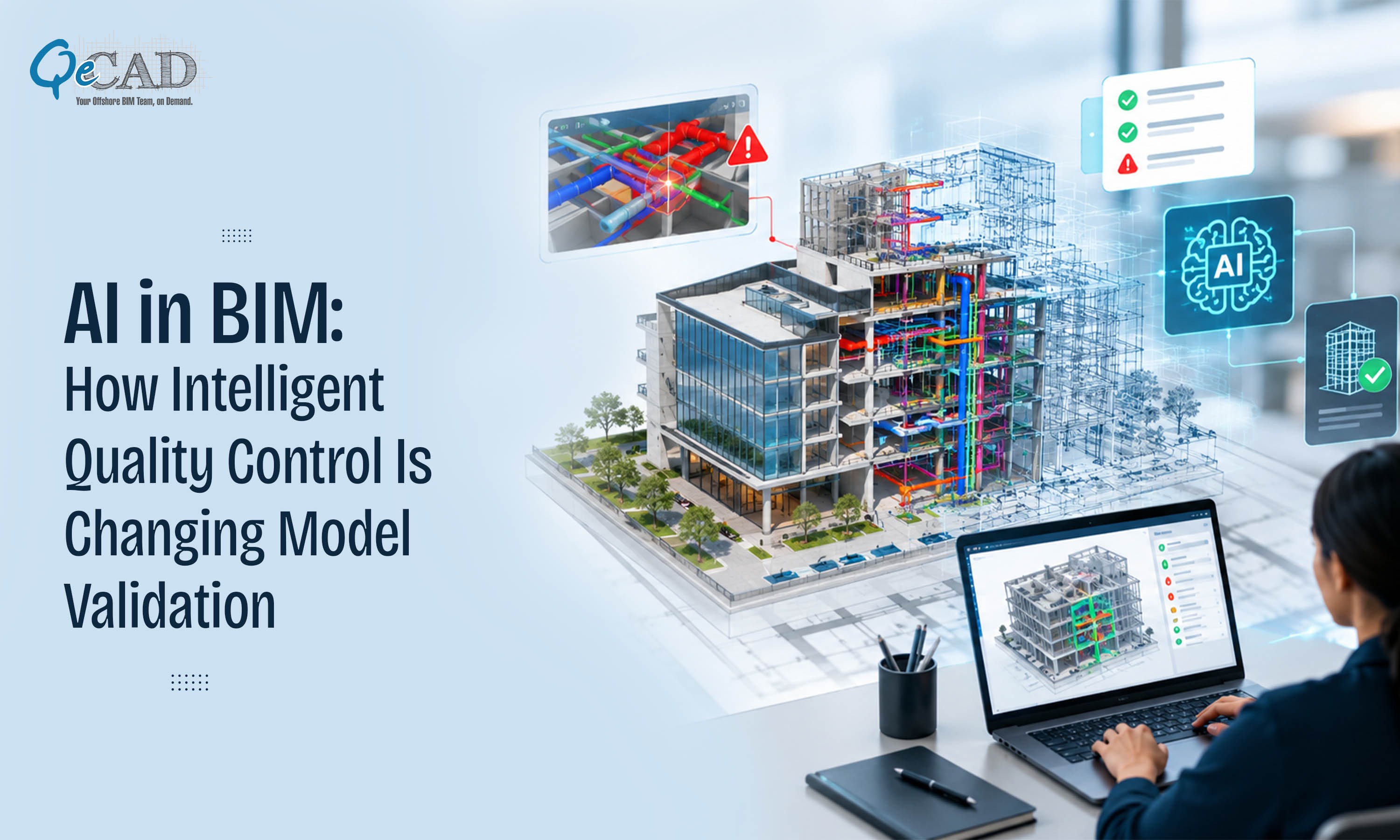
BIM has made design coordination more data-driven, but it has also created a new quality challenge: how do teams verify that a BIM model is actually correct?
A model can look visually complete and still contain incorrect parameters, missing information, poorly classified elements, duplicate objects, or coordination issues. Traditional quality control relies heavily on checklists, rule-based validation, clash detection, and human review. AI is now adding another layer—one that can analyze patterns, prioritize potential problems and learn from previously reviewed models.
But can machines really detect modeling errors?
Yes—but with an important qualification. AI can identify many types of errors and help prioritize them, but it does not replace technical judgment.
From Rule Checking to Intelligent Quality Control
Traditional BIM quality control generally follows predefined rules.
For example:
- Every door must have a fire rating.
- MEP equipment must contain specified parameters.
- Structural elements must follow defined classifications.
- Architectural and structural models must be coordinated.
- Required model elements must meet project LOD or information requirements.
These checks can already be automated. For example, buildingSMART’s Information Delivery Specification (IDS) enables project information requirements to be defined in a machine-readable format, allowing IFC models to be automatically validated for compliance. IDS can identify missing properties, incorrect values, classifications, and other information non-compliance.
AI extends this concept by moving beyond simple pass/fail rules.
Instead of asking only, “Does this element meet the rule?”, AI can potentially ask, “Does this element behave like similar elements that were previously accepted?”
That distinction is significant.
What Types of BIM Errors Can AI Detect?
AI-assisted quality control can support several categories of model checking.
- Geometric inconsistencies
AI can analyze model geometry to identify unusual dimensions, misplaced elements, abnormal relationships, or objects that deviate from expected patterns.
For example, if most walls within a building follow consistent thicknesses and one wall differs significantly without a design reason, an intelligent system could flag it for review.
- Missing or incorrect information
BIM models contain much more than geometry. Parameters, classifications, materials, specifications, equipment data, and relationships form an important part of the information model.
AI can identify incomplete or inconsistent data and compare model content against predefined project requirements.
- Clash prioritization
Clash detection is one of the most obvious applications.
Conventional clash detection can produce thousands of results, but not every intersection represents a genuine construction problem. Some are intentional, tolerable, or easily resolved.
Recent research published in Automation in Construction demonstrated a machine-learning approach for filtering and classifying BIM clashes. The study reported an F1-score and recall above 0.95 in its tested workflow, showing the potential for machine learning to replicate aspects of expert clash-filtering decisions.
This is where AI becomes particularly useful: not simply finding more clashes, but helping teams determine which clashes matter most.
How Does AI Actually Learn What an Error Looks Like?
AI quality control generally depends on data.
A simplified workflow is:
BIM Model → Data Extraction → Pattern Analysis → Error Prediction → Prioritization → Human Validation
The system may examine element type, geometry, location, parameters, relationships, previous issue classifications, and project-specific rules.
Suppose a BIM coordinator has reviewed thousands of clashes and consistently classified certain intersections as critical while ignoring others as intentional.
A machine-learning model can analyze these past decisions and use the patterns it identifies to inform future evaluations.
When a new model is submitted, the system can identify similar patterns and assign a probability or priority to potential issues.
This does not mean the AI understands construction in the same way an experienced coordinator does. It means it can recognize patterns in large datasets much faster than a person can.
AI Can Detect Patterns Humans May Miss
Large BIM projects contain thousands—or even millions—of objects and relationships.
Human reviewers naturally focus on high-risk areas, but repetitive data validation can become time-consuming. AI can continuously scan the model for anomalies without fatigue.
For example, it could identify:
- A family with inconsistent parameter values
- Duplicate or unusually positioned elements
- Missing asset information
- Unexpected relationships between building components
- Repeated modeling inconsistencies
- High-risk clash patterns
- Deviations from established project requirements
This creates an important shift in BIM quality assurance: from checking everything manually to intelligently directing human attention toward what needs investigation.
But AI Has a Major Limitation
A machine can identify that two objects intersect.
It cannot automatically determine whether that intersection is acceptable in the real construction context.
Consider an MEP penetration through a structural wall. Geometrically, the relationship may appear problematic. However, the opening could have been intentionally designed and structurally approved.
Similarly, a clash between a pipe and ceiling may be technically resolvable but still create an installation problem because of access, sequencing, maintenance clearance, or site constraints.
These decisions require engineering knowledge and project context.
Therefore, the most effective approach is not about choosing between AI and human expertise.
It is AI + BIM professionals.
The Future: Human-in-the-Loop BIM QA
The emerging model of BIM quality control is likely to be collaborative.
AI performs high-volume analysis, detects anomalies, classifies potential issues, and prioritizes risks. Experienced BIM professionals then validate those findings and make the final technical decision.
For organizations delivering BIM Modeling Services, this approach can make QA workflows more scalable without removing professional oversight.
A Dedicated BIM Team can establish project-specific rules, review AI-generated findings, validate critical clashes, and continuously improve the quality-control process based on real project experience.
This human-in-the-loop approach is essential because BIM quality extends beyond geometry and requires consideration of the broader project context. It involves constructability, information accuracy, standards, coordination, design intent, and project requirements.
So, Can Machines Detect Modeling Errors?
They can detect many errors—but detection is not the same as understanding.
AI is becoming increasingly capable of identifying anomalies, validating information, filtering clashes, and recognizing patterns across BIM datasets. Standards such as IDS are also making information requirements increasingly machine-readable and automatically verifiable.
The real opportunity is therefore not to remove humans from BIM quality control.
It is to give BIM professionals a smarter quality-control assistant—one that can scan enormous datasets, surface potential problems, reduce repetitive checking, and help experts focus on the decisions where experience matters most.
The future of BIM QA may not be error-free modeling. It may be intelligent error detection—where machines find the signals and people provide the judgment.