
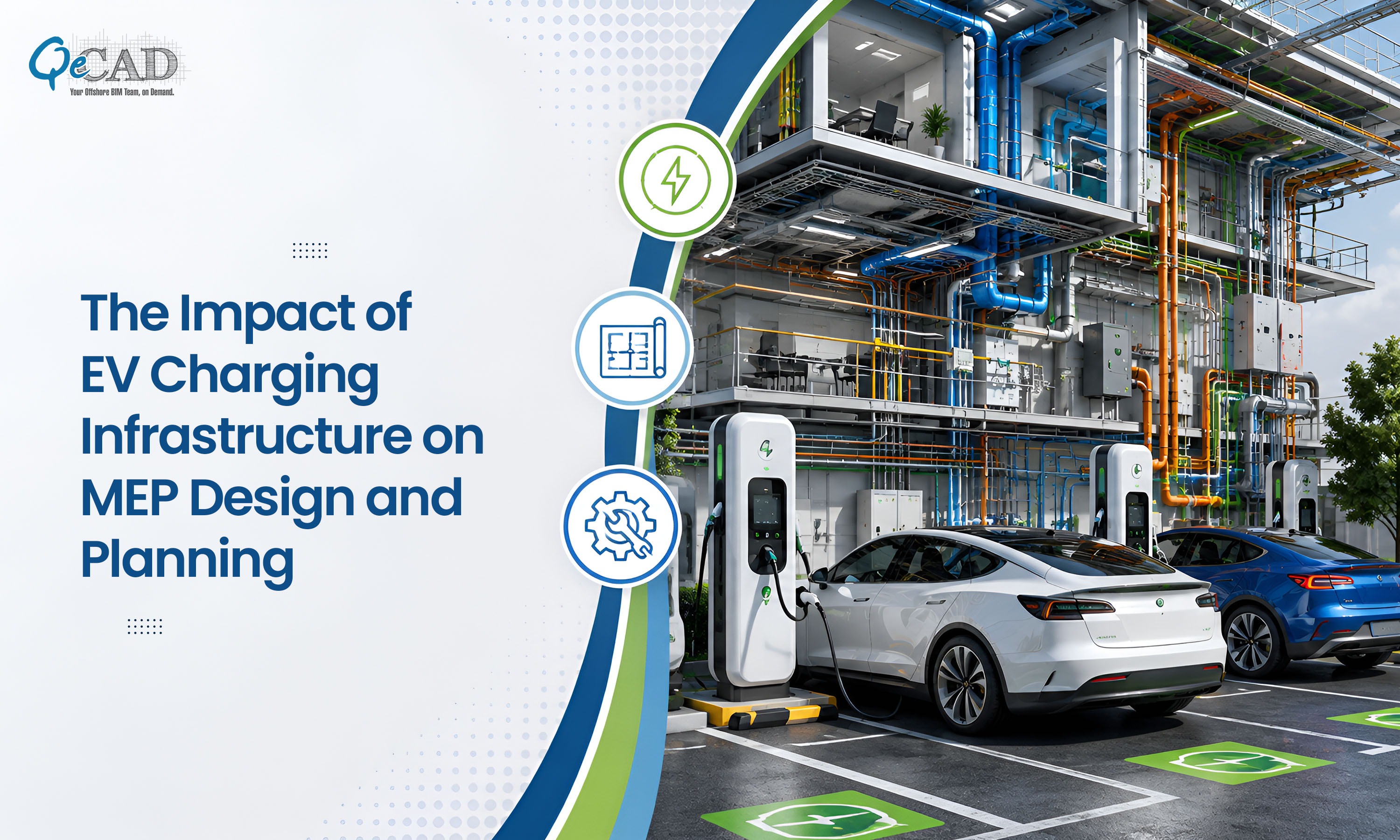
The rapid adoption of electric vehicles (EVs) is changing more than transportation—it is fundamentally altering how buildings are powered, planned and operated. As EV charging moves into residential complexes, offices, retail developments, hotels, airports, logistics facilities and public parking structures, MEP designers must treat charging infrastructure as an integral building system rather than an add-on.
The scale of this transformation is already substantial. According to the International Energy Agency (IEA), global public charging points exceeded 5 million in 2024, after more than 1.3 million new points were added during the year. In 2025, the average public charging capacity reached approximately 4.5 kW per electric light-duty vehicle globally, while ultra-fast chargers rated at 150 kW or more continued to expand.
This growth is creating new technical requirements for electrical distribution, HVAC, fire safety, spatial planning, controls and energy management. Consequently, MEP design is evolving from simply supporting building loads to coordinating building loads with transportation loads.
- Electrical Load Planning Is Becoming More Complex
The biggest impact of EV infrastructure on MEP design is the additional electrical demand.
An EV charger can represent a substantial load compared with the conventional building equipment. A development with dozens or hundreds of charging points can therefore significantly increase the project’s peak electrical demand. High-power DC charging can create especially demanding load profiles, potentially requiring larger transformers, switchgear, feeders, distribution boards and service connections.
This means EV charging must be considered during the earliest stages of electrical design.
Instead of designing the building’s electrical infrastructure first and finding space for EV chargers later, engineers increasingly need to assess:
- Number and type of EV chargers
- Charging power requirements
- Diversity and simultaneity factors
- Peak demand scenarios
- Transformer and switchgear capacity
- Feeder and cable sizing
- Voltage drop
- Future charging expansion
- Utility service capacity
The issue is particularly important for high-density developments and fleet facilities. The California Energy Commission notes that grid capacity is becoming a significant constraint for high-power EV charging, with utility upgrades potentially creating long and costly project delays.
- Load Management Is Becoming a Core Design Strategy
Installing maximum-capacity chargers everywhere is rarely the most efficient solution.
Smart charging and dynamic load management can distribute the charging demand according to the building consumption, available electrical capacity, time-of-use tariffs and vehicle requirements. For example, an office building could prioritize vehicle charging during periods when overall building demand is lower.
This changes the role of MEP engineers from designing static electrical systems to designing responsive energy systems.
The potential goes even further with bidirectional charging. The IEA reports that vehicle-to-grid (V2G) technology can support load shifting, frequency regulation and reduced peak demand, potentially limiting the need for additional grid investment.
Future-ready MEP designs therefore need to consider communication networks, energy-management systems, smart meters, charging-management platforms and potential integration with photovoltaic systems and battery energy storage.
- Parking Structures Are Becoming Electrical Infrastructure Zones
Traditional parking design primarily considered vehicle circulation, lighting, ventilation, drainage, and structural requirements. EV adoption adds another layer: electrical distribution.
MEP teams must coordinate charger locations with:
- Cable routes and containment
- Electrical rooms
- Distribution equipment
- Parking bay layouts
- Accessibility requirements
- Pedestrian circulation
- Protection from vehicle impact
- Drainage and environmental conditions
This is particularly challenging in existing buildings. Retrofitting EV charging may require routing new feeders through occupied areas, upgrading electrical rooms, increasing transformer capacity, or installing additional distribution equipment.
The IEA highlights that the revised EU Energy Performance of Buildings Directive includes provisions for pre-cabling parking infrastructure, recognizing that designing for future charging capacity can avoid expensive retrofit work.
- HVAC and Ventilation Design Are Also Evolving
EV charging can indirectly influence mechanical design.
Electrical rooms, battery energy storage systems, and charging equipment may generate additional heat that needs to be considered in thermal calculations. Large charging hubs can therefore affect equipment-room cooling requirements.
Designers must evaluate:
- Heat rejection from electrical equipment
- Equipment-room temperature requirements
- Ventilation requirements
- Battery energy storage integration
- Indoor charging environments
- Emergency ventilation provisions where applicable
While EVs eliminate tailpipe emissions within enclosed parking areas, the overall mechanical design still needs to account for electrical and energy-storage equipment.
- Fire and Life Safety Require Greater Coordination
EV infrastructure introduces new fire-safety considerations, particularly where lithium-ion batteries, charging equipment, and energy storage systems are involved.
MEP coordination may need to account for charger placement, emergency shutoffs, electrical protection, fire detection, access for emergency responders, equipment separation, and applicable local fire and electrical codes.
These requirements vary significantly by jurisdiction, making code coordination essential. For example, California’s current building standards incorporate EV-capable and EV-charging provisions for applicable developments, demonstrating how EV infrastructure is increasingly becoming part of mainstream building compliance.
- BIM Is Becoming More Valuable for EV-Ready Buildings
EV infrastructure adds another layer of coordination to already complex MEP systems. BIM can help teams visualize charger locations, electrical pathways, equipment clearances, service routes, and spatial conflicts before construction.
A coordinated BIM workflow can support:
- 3D placement of EV charging equipment
- Electrical containment coordination
- Clash detection
- Equipment clearance verification
- Load-related design documentation
- Construction sequencing
- As-built documentation
- Future expansion planning
For multidisciplinary projects, MEP BIM Services can help integrate EV charging infrastructure with architectural, structural, electrical, mechanical, and plumbing models while maintaining coordinated project information.
For projects that primarily require detailed 2D documentation, MEP Drafting Services can support accurate electrical layouts, schematic documentation, equipment schedules, conduit or cable-routing drawings, and construction documentation.
- EV Infrastructure Is Driving a Shift Toward Energy-Aware Buildings
Perhaps the most important change is conceptual.
Buildings are increasingly becoming energy ecosystems where HVAC, lighting, renewable generation, battery storage, building automation, and EV charging interact with one another.
According to the IEA, global EV electricity consumption reached approximately 180 TWh in 2024, marking nearly a 60% increase year over year. Under its stated-policies scenario, this demand is projected to rise to around 780 TWh by 2030, highlighting the growing impact of EVs on energy infrastructure.
For MEP designers, this means EV charging can no longer be treated as an isolated electrical accessory. It must be evaluated as part of the building’s overall energy strategy.
Conclusion
EV infrastructure is reshaping MEP design by introducing larger electrical loads, dynamic energy-management requirements, new parking coordination challenges, additional equipment-cooling considerations, and evolving fire and electrical safety requirements.
The most effective approach is to plan for EV infrastructure from the beginning—not retrofit it after the building is complete. By integrating charging capacity, smart load management, renewable energy, energy storage, BIM coordination, and future expansion into the design process, project teams can create buildings that are not only EV-ready but also more resilient and energy-aware.
As EV adoption accelerates, the question for MEP professionals is no longer whether buildings will need charging infrastructure. The more important question is whether today’s MEP designs are flexible enough to accommodate tomorrow’s charging demand.