
Introduction
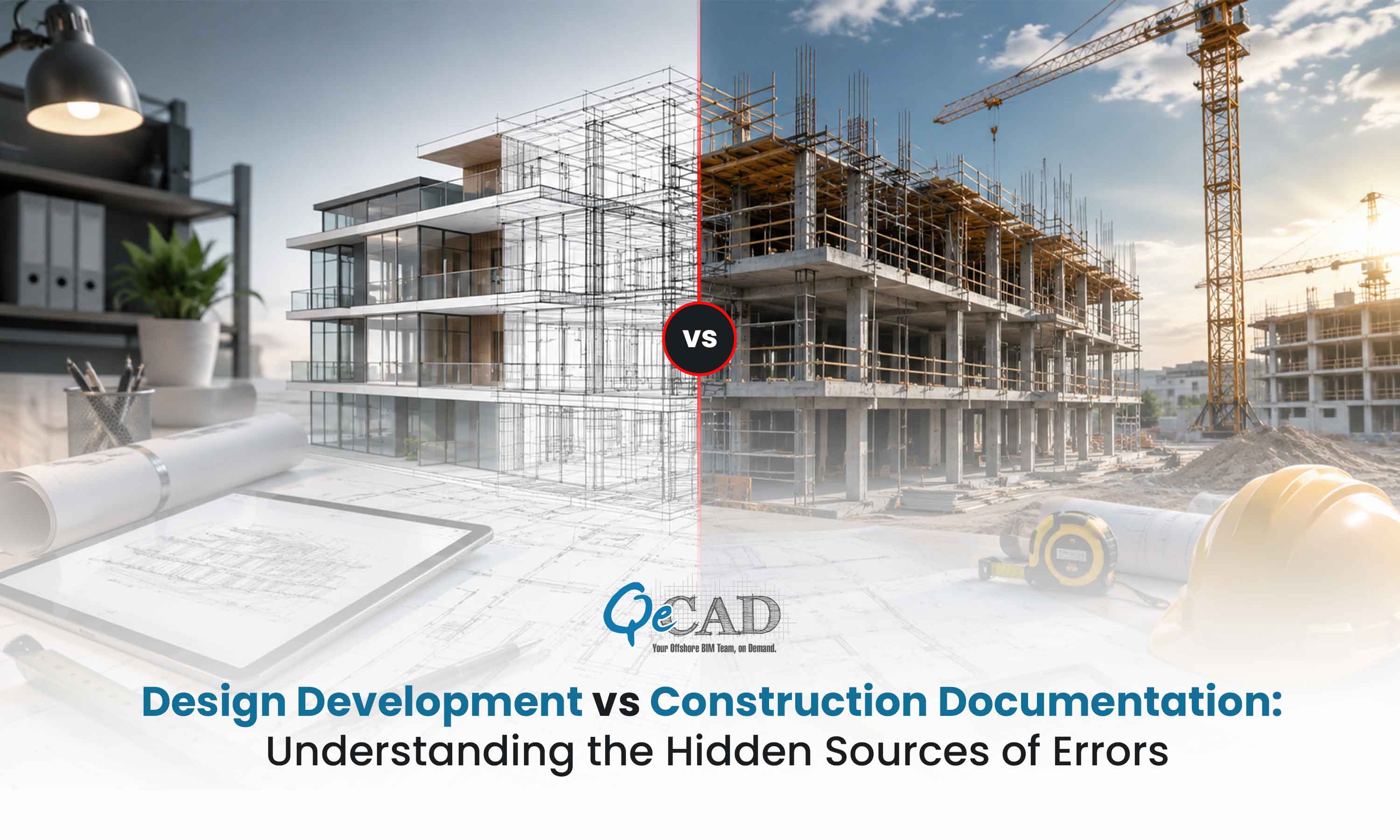
Construction projects rarely fail because of a single major mistake. More often, costly delays, reworks and coordination issues stem from inaccuracies that originates during the design development or become amplified during the construction documentation. Understanding where errors typically occur and how they impact the project delivery is essential for the architects, engineers, contractors and owners seeking better outcomes.
While both phases are interconnected, each serves a distinct purpose and presents unique risks. Identifying these vulnerabilities early enables the project teams to establish stronger workflows and reduce the downstream complications.
Understanding Design Development
Design Development (DD) transforms the conceptual ideas into a coordinated and technically refined design. During this phase, architectural layouts, structural systems, MEP configurations, material selections and spatial requirements are progressively defined.
Key activities includes:
- Refining floor plans and elevations.
- Establishing structural and MEP systems.
- Developing material specifications.
- Performing interdisciplinary coordination.
- Evaluating constructability and compliance requirements.
The objective is to convert the design intent into a buildable framework before the detailed documentation begins.
Understanding Construction Documentation
Construction Documentation (CD) represents the final set of drawings and specifications used for bidding, permitting, fabrication and construction. These documents communicates the precise dimensions, assemblies, schedules, notes and technical requirements.
Typical deliverables includes:
- Architectural drawings.
- Structural drawings.
- MEP drawings.
- Door and window schedules.
- Finish schedules.
- Sections and details.
- Specifications and general notes.
High-quality Construction Drawing Services ensures that these documents accurately convey the finalized design intent and minimizes the ambiguities during the construction.
Common Errors During Design Development
Although DD focuses on coordination, several issues frequently emerges:
Incomplete Interdisciplinary Coordination
Architectural, structural and MEP systems are often developed independently. Without proper collaboration, conflicts remain unnoticed until later stages.
Examples:
- Ducts intersecting structural beams.
- Equipment rooms lacking sufficient clearance.
- Ceiling heights conflicting with mechanical systems.
Frequent Design Changes
Owners and stakeholders may revise layouts, materials or functionality during the development. If modifications are not consistently communicated, inconsistencies propagates into later documents.
Lack of Constructability Review
Design solutions that appear feasible on paper may prove impractical during construction thus leading to the redesign and schedule impacts.
Undefined Materials and Systems
Insufficient specification of assemblies and products can create uncertainty during the documentation and procurement.
Common Errors During Construction Documentation
Construction documentation errors are generally more expensive because they directly affect field execution.
Inconsistent Drawings
Plans, sections, elevations and schedules may contain conflicting information.
Examples includes:
- Different dimensions across views.
- Mismatched room names.
- Missing annotations and tags.
Omissions
One of the most frequent causes of RFIs and change orders is incomplete documentation.
Common omissions includes:
- Missing details.
- Undefined connections.
- Incomplete schedules.
- Unspecified finishes.
Dimensioning Errors
Incorrect dimensions can result in fabrication problems, installation conflicts and material wastes.
Coordination Failures
Changes introduced late in the design process may not be reflected across all the disciplines, causing clashes between systems.
Revision Management Issues
Improper version control often results in outdated drawings reaching contractors or fabricators, creating confusion and rework.
Where Do Most Errors Actually Occur?
Although many coordination challenges originates during the Design Development, industry experience shows that the majority of costly errors become evident during the Construction Documentation and construction execution.
Errors Originating in Design Development
- Inadequate coordination.
- Incomplete decisions.
- Unresolved spatial conflicts.
- Late design modifications.
Errors Manifesting in Construction Documentation
- Missing information.
- Drawing discrepancies.
- Incorrect dimensions.
- Coordination mismatches.
- Specification inconsistencies.
In other words, Design Development creates the foundation, while Construction Documentation exposes and amplifies unresolved issues. Errors that remain unnoticed during DD become significantly more expensive once they appear in CD.
Why Documentation Errors Have Greater Financial Impact?
The cost of correcting errors increases dramatically as projects progress.
| Project Phase | Relative Cost of Correction |
| Concept Design | Low |
| Design Development | Moderate |
| Construction Documentation | High |
| Construction Phase | Very High |
| Post-Construction | Extremely High |
A simple coordination issue identified during DD may require only hours to resolve, whereas the same issue discovered on-site could result in delays, change orders, material waste, and labor disruptions.
Strategies to Minimize Errors
Strengthen Early Coordination
Regular collaboration between architecture, structure, and MEP disciplines helps identify clashes before documentation begins.
Standardize Drawing Procedures
Consistent templates, naming conventions, and quality-control processes improve document accuracy.
Implement Multi-Level Reviews
Peer reviews and interdisciplinary checks can detect inconsistencies before drawings are issued.
Leverage Digital Workflows
Modern CAD Drawing Services and BIM platforms facilitate clash detection, revision management, and enhanced collaboration among stakeholders.
Maintain Strict Version Control
Document management systems help ensure that teams work from the latest approved drawings.
Conduct Constructability Assessments
Early contractor involvement and constructability reviews help identify potential field issues before they become costly problems.
Conclusion
Design Development and Construction Documentation are not competing phases; they are sequential processes that depend heavily on each other. While many errors originate during Design Development, the most expensive and disruptive problems typically surface during Construction Documentation because unresolved issues become embedded within the documents used for construction.
Successful projects rely on rigorous coordination, disciplined review processes, and accurate documentation. By investing in quality control throughout both stages, project teams can significantly reduce RFIs, change orders, delays, and costly rework, ultimately delivering more predictable and efficient construction outcomes.