
Introduction
The construction industry is entering a new era where robotics, automation and intelligent digital workflows are transforming how the buildings are designed, constructed and maintained. Labor shortages, increasing project complexity, tighter schedules and growing demands for quality are driving the contractors to adopt the robotic technologies for tasks such as layout marking, bricklaying, rebar tying, concrete printing, material handling and autonomous site inspections.
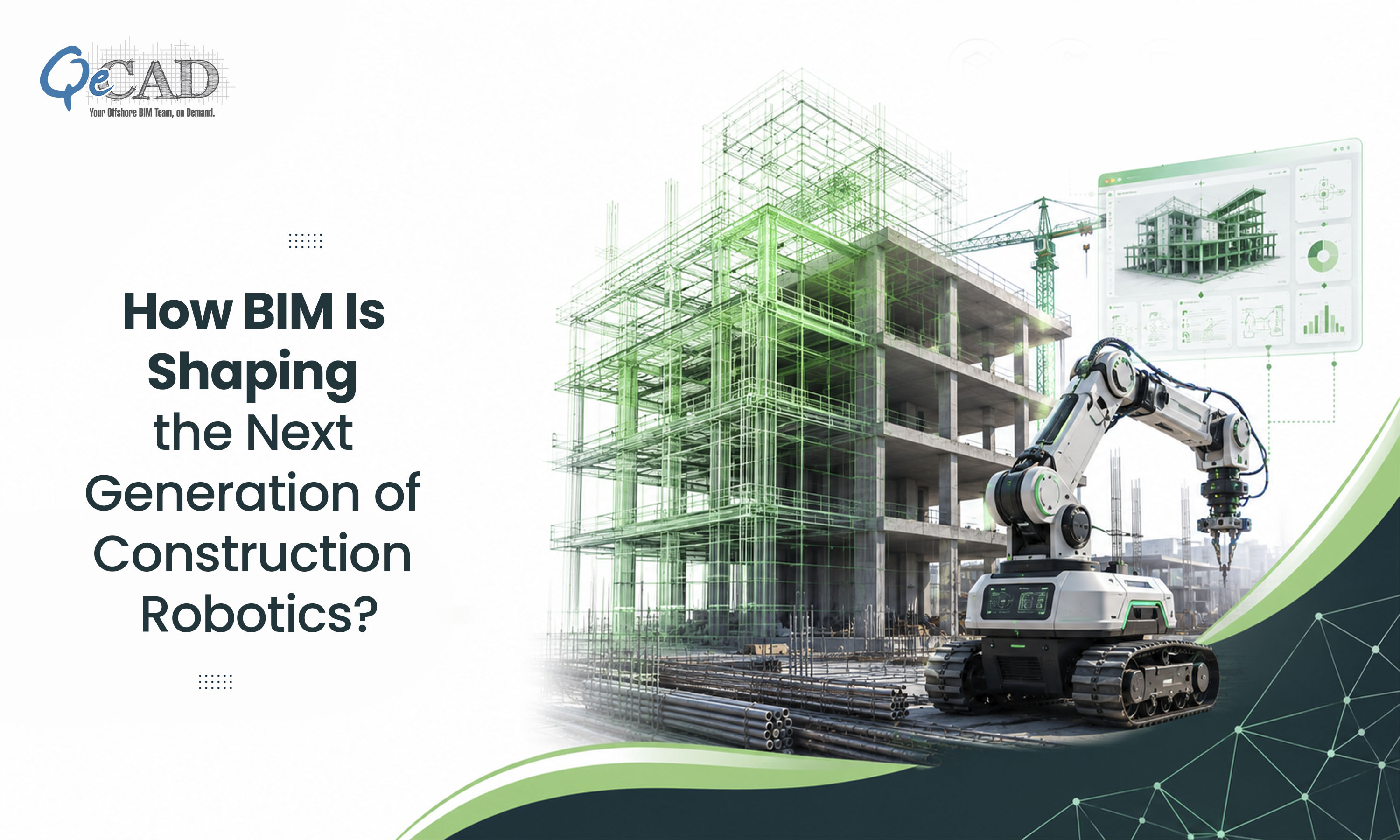
However, robots cannot operate efficiently without accurate digital information. This is where BIM becomes the foundation of automation. BIM provides the structured, information-rich digital models that guides the robotic systems with precise geometry, sequencing and construction data throughout the project lifecycle.
According to the industry estimates, the global construction robotics market is projected to surpass USD 8 billion by 2030, growing at a strong CAGR as automation becomes more of mainstream. At the same time, digital transformation studies indicates that BIM adoption continues to rise across the commercial and infrastructural projects due to its measurable impact on productivity, coordination and cost reduction.
This convergence of BIM and robotics is redefining the construction from manual execution to intelligent, data-driven project delivery.
Understanding BIM in Automated Construction
BIM isn’t just a 3D model but more than that. It is a centralized digital database containing the geometric information, engineering specifications, material properties, schedules, quantities, maintenance data and project documentation.
When connected with the robotic systems, BIM becomes the operational intelligence that enables the machines to perform the construction tasks accurately.
Instead of relying solely on human interpretation of drawings, robots receives the structured digital instructions extracted directly from the BIM models, allowing them to:
- Navigate the construction sites
- Identify work locations
- Understand the component dimensions
- Execute repetitive tasks
- Verify completed work
- Update the construction progress
This digital continuity significantly reduces the manual interpretation errors while improving the consistency across the projects.
Why Construction Robotics Requires BIM?
Construction robots depends on accurate digital models to perform physical activities.
Without BIM:
- Dimensions may be inconsistent.
- Coordination errors increases.
- Site layouts become unreliable.
- Robots requires extensive manual calibration.
With BIM, robotic systems gain access to:
- Accurate coordinates
- Component placement
- Construction sequencing
- Material information
- Installation tolerances
- Clash-free design data
The result is faster deployment with fewer operational errors.
Applications of BIM in Construction Robotics
- Robotic Site Layout
Construction layout robots automatically marks wall locations, MEP routes, anchor positions and structural grids directly from the BIM models.
Instead of manually measuring every location, robotic layout systems interprets the model coordinates and transfers them precisely onto the construction site.
Benefits includes:
- Higher layout accuracy
- Reduced surveying time
- Lower reworks
- Faster project startup
- Autonomous Bricklaying
Modern robotic bricklaying systems can place hundreds of bricks per hour using the BIM-generated wall geometry.
The BIM model provides:
- Wall dimensions
- Openings
- Joint spacing
- Brick patterns
- Installation sequence
The robot executes these instructions with minimal manual intervention.
- Robotic Rebar Installation
Reinforcement placement is labor-intensive and highly repetitive.
BIM models already contain:
- Rebar sizes
- Bending schedules
- Placement coordinates
- Structural relationships
These datasets enables the robotic systems to automate the portions of reinforcement assembly while maintaining the design accuracy.
- Robotic Concrete Printing
Large-scale 3D concrete printers rely entirely on the digital models.
BIM provides:
- Layer geometry
- Wall thickness
- Structural dimensions
- Printing paths
The printer converts the BIM geometry into machine instructions thus enabling the automated construction with minimal formwork.
- Automated Material Handling
Autonomous vehicles and robotic material transport systems uses BIM to identify:
- Material storage locations
- Delivery routes
- Installation zones
- Floor sequencing
This minimizes the unnecessary movement across the busy construction sites.
- Drone and Robotic Site Inspection
Inspection drones compares the real-world conditions with the BIM models.
Using LiDAR, photogrammetry and AI-powered image recognition, they can identify:
- Construction deviations
- Missing components
- Installation errors
- Progress percentages
- Safety risks
This enables near real-time quality control throughout the construction.
BIM as the Digital Brain of Automated Building Systems
Automation extends beyond the construction into building operations.
Modern smart buildings integrates:
- HVAC automation
- Lighting control
- Security systems
- Energy monitoring
- Occupancy sensors
- Fire safety systems
BIM serves as the centralized digital representation connecting these systems.
Facility managers can visualize the equipment, monitor assets and manage the maintenance using BIM-integrated digital twins.
This creates continuous information flow from the construction through the facility management.
Integration of BIM with Artificial Intelligence
AI enhances BIM by enabling intelligent decision-making.
Combined with robotics, AI can:
- Optimize robot movements
- Predict equipment failures
- Detect design inconsistencies
- Improve the construction sequencing
- Automate the quality inspections
Machine learning algorithms continuously analyses the construction data to improve the robotic performance over time.
Digital Twins and Autonomous Construction
Digital twins represents the live digital replicas of physical buildings.
Combined with BIM and IoT sensors, digital twins provide automated systems with the real-time intelligence needed to:
- Monitor the construction progress
- Compare planned versus actual work
- Detect deviations instantly
- Support predictive maintenances
- Improve the operational efficiency
Many large commercial facilities now uses BIM-enabled digital twins throughout their operational lifecycle, extending the value of construction data long after the project completion.
Benefits of BIM in Construction Robotics
Improved Accuracy
Robotic systems execute the tasks using the exact model coordinates, significantly reducing the dimensional errors.
Reduced Reworks
Accurate digital information minimizes the installation mistakes and coordination issues.
Industry studies estimate that rework can account for up to 5–15% of total construction costs, making improved model accuracy a significant financial advantage.
Faster Project Delivery
Automation accelerates the repetitive construction activities while BIM ensures consistent execution.
The combination helps to compress the project schedules without compromising the quality.
Enhanced Worker Safety
Robots increasingly performs hazardous tasks such as:
- High-elevation inspections
- Heavy lifting
- Demolition assistance
- Hazardous material handling
This reduces the worker exposure to dangerous environments.
Better Resource Management
BIM enables robotic systems to optimize:
- Material usage
- Equipment utilization
- Construction sequencing
- Workforce allocation
The result is improved productivity across the project.
Challenges in BIM-Driven Construction Automation
Despite its advantages, implementation poses several challenges.
High Initial Investment
Robotics, BIM software, laser scanning equipment and AI platforms requires substantial upfront investment.
However, the long-term gains often offsets these costs through higher productivity and reduced reworks.
Data Accuracy
Robots depend entirely on reliable BIM data.
Incomplete or outdated models can lead to construction errors.
Maintaining accurate, coordinated models is therefore essential.
Interoperability
Construction projects involves multiple software platforms.
Ensuring seamless data exchange between the BIM platforms, robotic systems, IoT devices and project management software remains an ongoing industry challenge.
Open standards such as IFC continues to improve interoperability.
Workforce Skills
Successful implementation requires professionals with expertise in:
- BIM modeling
- Robotics
- Automation
- Data management
- AI-assisted construction
The industry continues investing in the workforce training to address this evolving skill set.
Future Trends
The next generation of automated construction will increasingly rely on BIM as the central digital platform.
Emerging trends includes:
- AI-powered autonomous construction sites
- Self-navigating construction equipment
- Robotic quality assurance
- Autonomous façade installation
- BIM-integrated warehouse robotics
- Human-robot collaborative construction
- Real-time digital twin synchronization
- Cloud-connected robotic fleets
As these technologies matures, BIM will evolve from a design platform into the operational backbone of intelligent construction ecosystems.
How Professional BIM Partners Support Construction Automation?
Organizations planning to adopt the construction robotics requires highly accurate BIM models capable of supporting automated workflows.
Professional BIM Services ensures that the models are coordinated, information-rich and compatible with the robotic systems, digital twins and smart building technologies. Similarly, comprehensive Construction Documentation Services provides accurate drawings, specifications and installation details that aligns the digital models with the on-site execution, enabling the automation with greater confidence and precision.
Conclusion
Construction robotics is reshaping the future of the built environment, but automation is only as effective as the digital information that drives it. BIM provides the structured data, spatial intelligence and coordination required for the robots to execute the construction tasks with precision while supporting smarter decision-making throughout the project lifecycle.
As robotics, AI, IoT and digital twins continues to converge, BIM will remain the foundation connecting the design, construction and facility operations into one intelligent ecosystem. Organizations that invest in the robust BIM workflows today will be better positioned to deliver faster, safer and more efficient projects in an increasingly automated construction industry.