
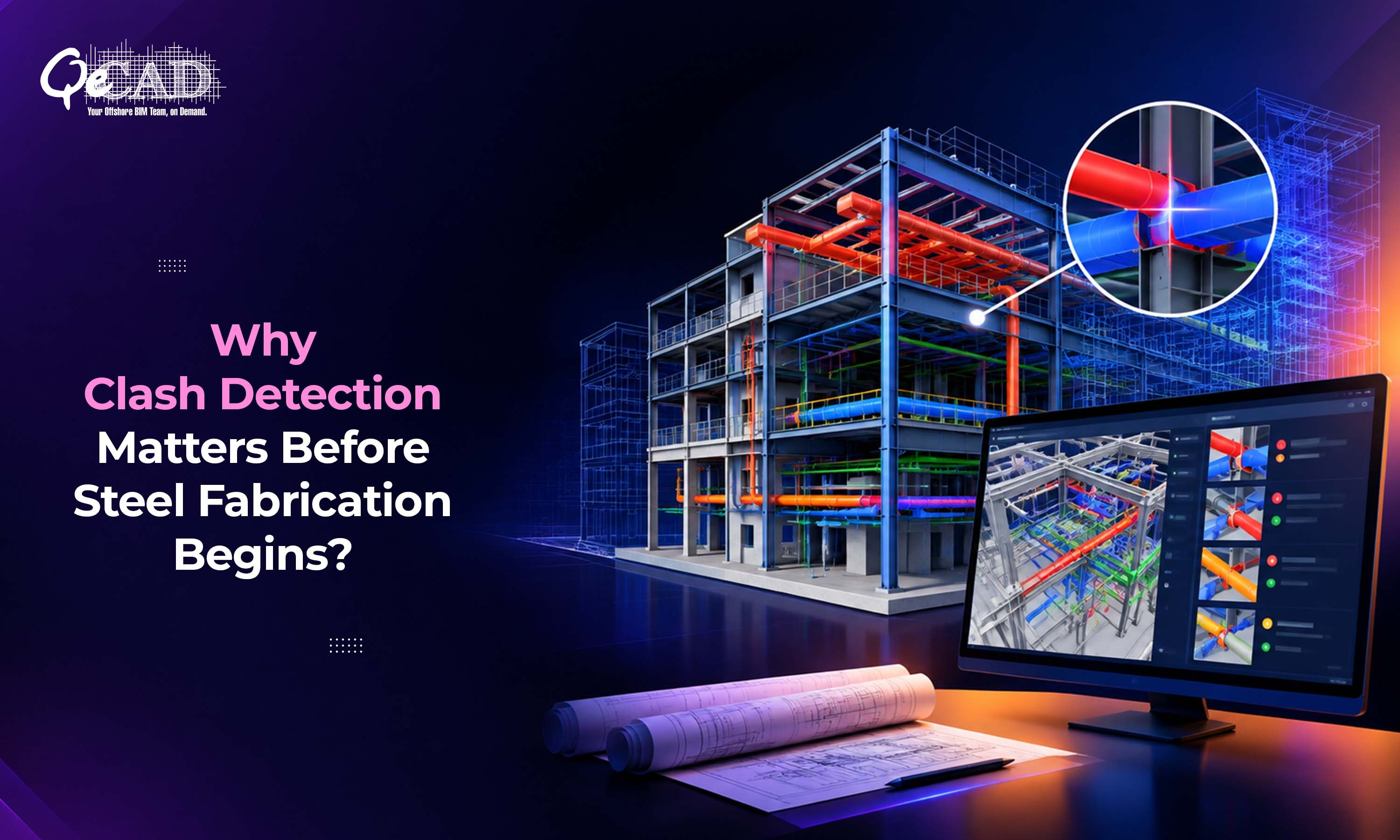
Steel structures are often designed around tight dimensional relationships. A beam may need to connect precisely to a column, a brace may pass through a congested service zone, and a connection plate may depend on millimeter-level alignment with another component. When these relationships are not coordinated before fabrication, seemingly minor design conflicts can become expensive problems in the shop or on site.
This is where clash detection becomes more than a coordination exercise. When integrated into the structural workflow, it can identify geometric, clearance, and constructability issues before steel is cut, drilled, welded, transported, or erected.
Why Steel Fabrication Problems Often Begin in Design?
Fabrication errors are not always caused by incorrect detailing. Many originate from coordination gaps between structural design, architectural requirements, MEP services, and connection details.
For example, a steel beam may be structurally correct but occupy the same space required for a large duct. A brace may conflict with a pipe route, while a connection plate may interfere with an adjacent member. Such issues can remain hidden when drawings are reviewed individually because each discipline may appear correct within its own scope.
A coordinated 3D model changes this perspective. Instead of examining components independently, teams can evaluate how structural members interact within the actual project environment.
What Clash Detection Identifies in Steel Projects?
Clashes in steel projects generally fall into several categories.
A hard clash occurs when two building elements intersect or occupy the same physical space. A beam intersecting a duct or a brace passing through another structural member is a typical example.
Clearance clashes occur when components technically do not intersect but do not provide sufficient space for installation, maintenance, welding, bolting, or access.
Soft clashes relate to required spatial tolerances or operational zones. For example, a steel connection may technically fit but leave inadequate clearance for a worker to install bolts safely.
There are also workflow-related conflicts. A member may be modeled correctly but require a fabrication sequence that is difficult to execute. Detecting these issues early helps teams consider constructability rather than geometry alone.
From Model Coordination to Fabrication Readiness
Effective clash detection should not stop at identifying an intersection. The real value comes from understanding its consequence.
Consider a steel beam passing through an MEP service zone. Simply flagging the clash is not enough. The coordination team must determine whether the beam should be repositioned, the service rerouted, or the structural solution revised.
The same principle applies to connections. A connection can be geometrically valid while still creating problems with bolt access, welding space, erection sequence, or adjacent members.
This makes clash detection an iterative process:
Model → Detect → Review → Resolve → Validate → Fabricate
Each cycle progressively improves the reliability of the coordinated model.
Preventing Fabrication Rework
Once steel reaches fabrication, design changes become considerably more expensive. Incorrect member dimensions, connection geometry, hole locations, or plate configurations can result in material waste and production delays.
Integrating Clash Detection Services into the pre-fabrication workflow helps identify conflicts while changes are still relatively inexpensive.
For instance, detecting that a brace interferes with an architectural opening during coordination allows the team to resolve the issue digitally. Discovering the same problem after fabrication may require cutting, modification, re-welding, repainting, or even remanufacturing.
The objective is therefore not simply to achieve a clash-free model. It is to reduce the probability that unresolved coordination issues reach the fabrication floor.
Improving Fabrication Drawings
Fabrication drawings translate coordinated design information into instructions that shop and site teams can act upon. They must communicate member sizes, connection details, dimensions, bolt arrangements, weld information, material specifications, and other fabrication requirements accurately.
When these drawings are generated from a properly coordinated model, the likelihood of discrepancies between the model and documentation can be reduced.
Professional Fabrication Drawing Services can support this workflow by developing detailed drawings from coordinated structural models while incorporating resolved coordination information. This creates a more reliable connection between design intent, fabrication requirements, and erection planning.
Reducing Erection Problems on Site
Many steel erection problems are not discovered until components arrive at the project site. A fabricated member may technically match its drawing but fail to fit because another element occupies the required space.
Common consequences includes:
- Field modifications to fabricated steel
- Unplanned cutting and drilling
- Connection alignment problems
- Crane and lifting sequence disruptions
- Delays caused by missing or inaccessible connections
- Additional surveying and rework
- Increased safety and labor risks
Clash detection can help address these issues before delivery by simulating how members interact within the coordinated structure.
Erection sequencing can also be considered during coordination. Temporary access, lifting paths, connection accessibility, and member installation order may influence whether a theoretically correct solution is practically executable.
Clash-Free Does Not Always Mean Buildable
One of the most important limitations of automated clash detection is that software can identify geometric conflicts, but it cannot independently determine every constructability concern.
A model may contain no obvious intersections and still create problems because of insufficient wrench clearance, difficult weld access, erection tolerances, or installation sequencing.
Therefore, effective coordination combines automated detection with engineering judgment and fabrication experience.
The question should not simply be:
“Do these elements clash?”
It should also be:
“Can these elements be fabricated, transported, connected, and erected as intended?”
That shift transforms clash detection from a model-checking activity into a constructability process.
A More Reliable Steel Delivery Workflow
A coordinated steel workflow can be structured around several checkpoints:
- Design Coordination: Integrate structural, architectural, and MEP information.
- Model Validation: Check member geometry, levels, connections, penetrations, and clearances.
- Clash Detection: Identify hard, clearance, and constructability-related conflicts.
- Resolution: Assign responsibility, evaluate alternatives, and document approved solutions.
- Fabrication Documentation: Update models and drawings with resolved coordination information.
- Pre-Erection Verification: Review critical connections, interfaces, access requirements, and erection constraints.
This approach moves problem-solving upstream, where changes are easier and less costly to implement.
Conclusion
Steel fabrication and erection depend on more than accurate structural calculations. They depend on coordinated geometry, accessible connections, reliable documentation, and practical constructability.
Clash detection provides an opportunity to identify problems before they become fabrication errors or site delays. But its greatest value comes when it is connected to model review, engineering judgment, fabrication detailing, and erection planning.
The goal isn’t just to create a model with fewer clashes. It is to create a coordinated digital representation that gives fabricators and erectors greater confidence in what they are being asked to build.
In that sense, effective clash detection is not the final quality check before fabrication. It is a proactive decision-making tool that improves predictability across the entire steel delivery process—from design to erection.