
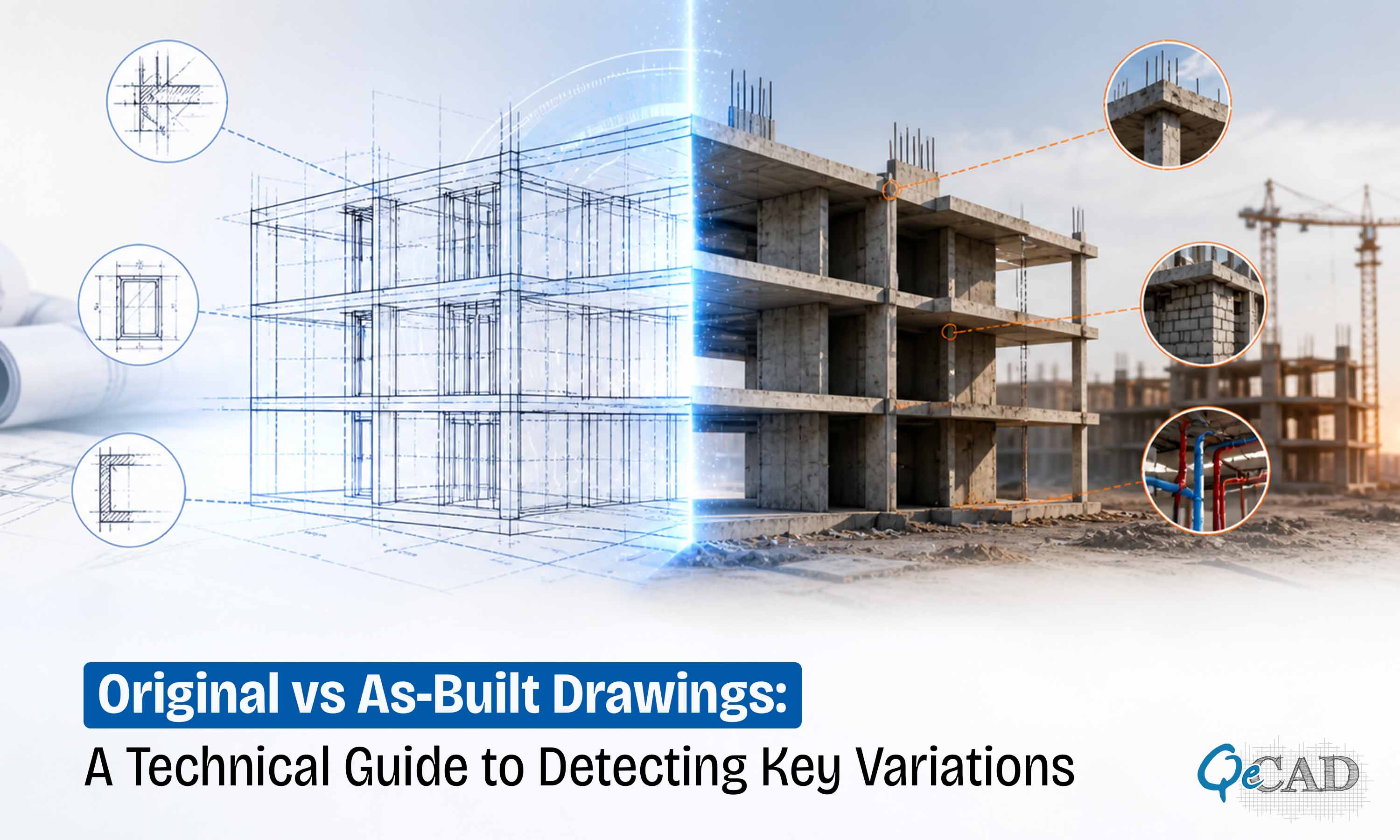
In the lifecycle of any construction project, the drawings serves as the backbone of planning, execution and facility management. However, what is designed on paper rarely translates perfectly into what is constructed on-site. This is where the comparison between the original drawings and as-built drawings becomes crucial. Understanding and identifying deviations between the two is essential for ensuring the project accuracy, safety and long-term operational efficiency.
Understanding Original Drawings
Original drawings—commonly known as the design or construction drawings—illustrates the initial vision of the architects/engineers. These documents defines the dimensions, materials, layouts and technical specifications required for execution. They are used for approvals, cost estimations and guiding the construction teams.
However, despite their precision, these drawings are based on assumptions and planned conditions that may change during the execution due to the site constraints, unforeseen challenges or design modifications.
What Are As-Built Drawings?
As-built drawings capture the actual conditions of a structure once the construction is complete. They incorporate all the changes made during the building process, whether intentional or due to on-site adjustments.
Professionally developed As Built Drawing Services ensures that these updates are accurately captured, providing a reliable record of the final constructed asset. These drawings are critical for maintenances, renovations and future expansion projects.
Why Deviations Occur?
Deviations between the original and as-built drawings are inevitable. Some common causes includes:
- Site Conditions: Unexpected soil conditions, existing utilities or structural constraints
- Material Availability: Substitution of materials due to cost or supply chain issues
- Design Changes: Client-driven or regulatory modifications during the construction
- Human Error: Misinterpretation of the drawings or execution inaccuracies
- Coordination Issues: Conflicts between the architectural, structural and MEP systems
Types of Critical Deviations
Identifying deviations is not just about spotting the differences—it’s about recognizing those that have significant implications.
- Structural Deviations
Changes in beam sizes, column placements or load-bearing elements can impact the safety and integrity of the building.
- Dimensional Variations
Even minor discrepancies in measurements can affect the installation, alignment and functionality of the building components.
- MEP System Changes
Alterations in mechanical, electrical and plumbing layouts can lead to inefficiencies or maintenance challenges if not properly documented.
- Compliance-Related Deviations
Any deviations from the approved plans may lead to regulatory issues, penalties or delays in the occupancy certification.
Methods to Identify Deviations
Modern construction projects rely on the advanced technologies to accurately detect and document differences between the planned and the actual conditions.
Laser Scanning & Reality Capture
High-precision laser scanners captures the exact geometry of built structures, generating the point cloud data for comparison.
Digital Overlay Techniques
Overlaying as-built data on the original drawings in CAD or BIM environments helps to visualize the deviations clearly.
BIM-Based Clash Detection
Using BIM tools, the teams can identify the inconsistencies and conflicts between the different building systems.
Scan to BIM Services
By converting the point cloud data into intelligent 3D models, Scan to BIM Services enables a detailed comparison between the design intent and actual construction thus improving the accuracy and decision-making.
Impacts of Unidentified Deviations
Failing to detect and document deviations can lead to:
- Increased maintenance costs
- Safety risks and structural failures
- Delays in renovation or retrofit projects
- Legal disputes and compliance issues
- Inefficient facility management
Best Practices for Managing Deviations
To ensure the effective deviation management, consider the following practices:
- Continuous Documentation: Update drawings in real-time during the construction
- Regular Site Surveys: Conduct periodic checks using the advanced scanning tools
- Cross-Disciplinary Coordination: Ensure seamless communication between teams
- Leverage BIM Workflows: Maintain a centralized digital model for tracking the changes
- Quality Control Processes: Implement strict review mechanisms for accuracy
Conclusion
The gap between the original drawings and as-built conditions is where many project risks and inefficiencies emerges. Identifying and addressing the critical deviations goes beyond a technical requirement—it delivers a strategic advantage.
Accurate as-built documentation ensures that the stakeholders have a true representation of the constructed asset thus enabling better decision-making across the building lifecycle. As construction projects grows more complex, leveraging advanced technologies and structured workflows will be the key to bridging the gap between the design intent and on-site reality.