
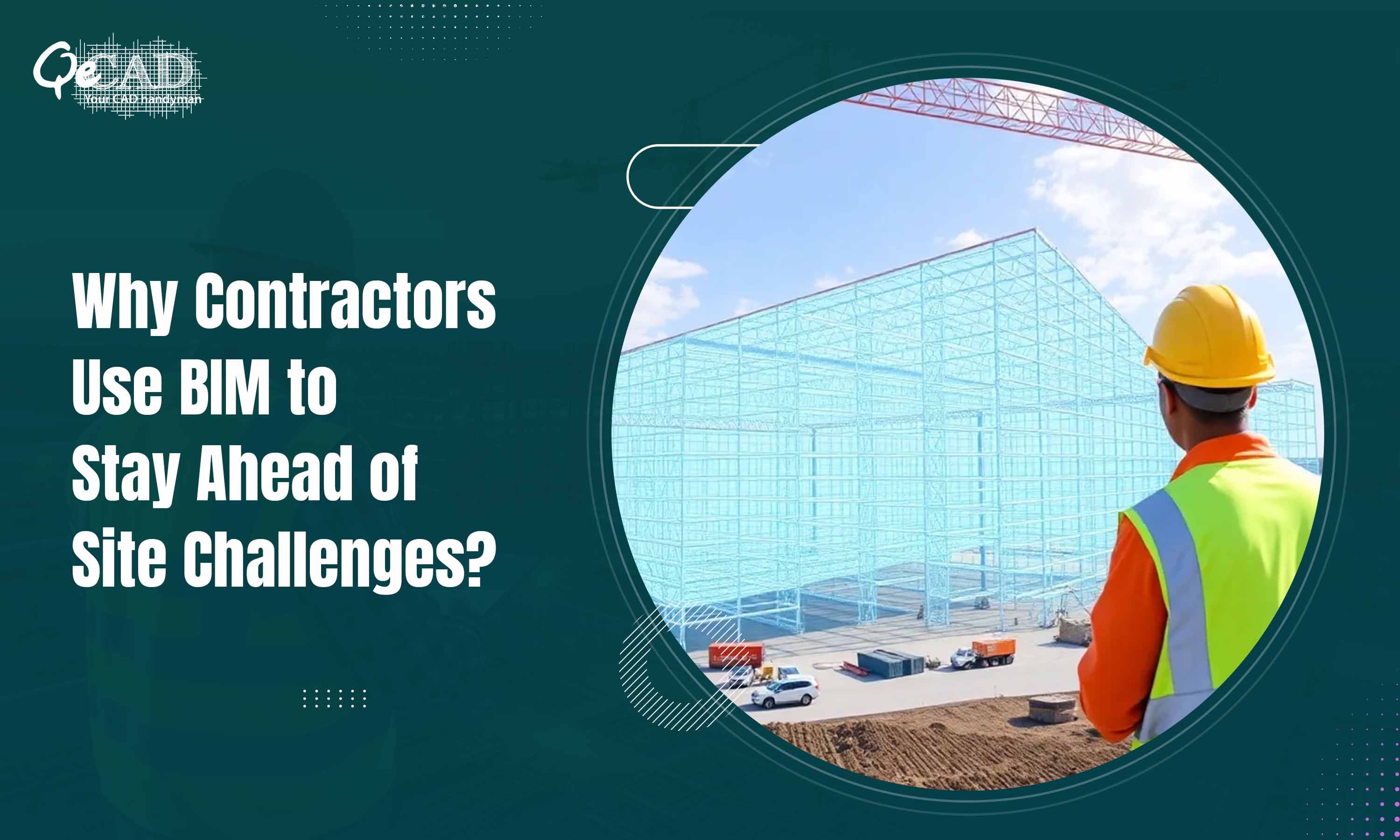
In the modern construction landscape, proactive planning and coordination are paramount. Gone are the days when the contractors reacted to the issues on site — today, many problems are resolved months before the first shovel hits the ground. The secret – BIM.
BIM isn’t just a 3D visualization tool; it’s a collaborative platform that enables all the stakeholders to work from a single, data-rich model throughout the project lifecycle. In doing so, BIM significantly reduces the ambiguities, improves decision-making and minimizes the costly site queries that historically slow the projects down.
Contractors’ Traditional Challenge: Site Queries and RFIs
On traditional projects, site queries often arise when the field teams encounter discrepancies between the design documents and actual conditions. These queries — frequently generated as Requests for Information (RFIs) — cause delays, increase costs and strain relationships between the contractors and designers.
According to industry data, an average construction project can generate hundreds of RFIs, with each RFI costing approximately $1,080 in administrative and technical response costs alone.
How BIM Reduces Site Queries Before They Occur?
- Centralized, Data-Rich 3D Modeling
The foundation of BIM is a 3D intelligent model where every component of a building — from walls to HVAC systems — is linked with the rich metadata. This digital representation removes much of the guesswork that inevitably leads to the site queries.
Because the model shows exactly how different components fit together, contractors gain clarity on the design intent long before the construction begins thus reducing the confusion and ambiguity that typically triggers RFIs.
- Automated Clash Detection and Coordination
One of the most impactful features of BIM is automated clash detection. By integrating the architectural, structural and MEP systems within the same model, BIM software automatically highlights the spatial conflicts that would otherwise show up on site — where they are most expensive and disruptive.
Studies have shown that using BIM to detect clashes before the construction can reduce RFIs by up to 68% in some projects hence directly translating to fewer site queries and lower rework costs.
- Real-Time Collaboration Through Common Data Environments (CDE)
Modern BIM workflows often leverage the cloud-based platforms (like Autodesk BIM 360, Revit Cloud Worksharing, etc.) where all the project stakeholders work from the latest model version. This Common Data Environment (CDE) ensures that everyone — from the BIM for General Contractor team to specialty subcontractors — views the same information in real time.
This means queries are resolved virtually in minutes — not days — and often before they reach the field thus reducing the time-consuming back-and-forth communication.
- Pre-construction Visualization and Simulation
BIM enables the contractors to perform 4D scheduling — adding time as a fourth dimension to the 3D model — to simulate the construction sequences. Contractors can then visualize the workflows, trade formations, equipment sequencing and access logistics before the construction starts.
By anticipating the potential bottlenecks and constructability challenges virtually, many issues are eliminated early thereby avoiding the questions that would normally arise once the crews are on site.
- Accurate Quantity Take-offs and 5D Cost Linking
Beyond clash detection and visualization, BIM also supports 5D cost estimation — integrating the cost data with the model. This functionality allows the contractors to extract the accurate quantities and build the realistic cost forecasts.
Accurate take-offs and cost linkages helps in avoiding the errors in procurement and budgeting that typically leads to queries about materials, quantities or change orders during the construction.
Real-World Example: Sutter Health’s Castro Valley Medical Center
A powerful real-world testament to BIM’s ability to reduce the site queries comes from the Sutter Health Castro Valley Medical Center project. Using BIM extensively during preconstruction, the team identified thousands of clashes — including over 500 serious coordination issues — before even the construction started.
By resolving these issues virtually, Sutter Health’s team drastically cut down on RFIs and costly reworks in the field, ultimately streamlining the site execution and optimizing the labor and materials.
Quantifiable Benefits Contractors Experience with BIM
Here’s a quick summary of measurable impacts that BIM delivers particularly in reducing the site queries and improving the overall project delivery:
- Up to 68% reduction in RFIs through early clash detection and BIM coordination.
- Significant reduction in reworks and change orders, resulting in greater certainty around project schedules and costs.
- Enhanced collaboration and real-time access to the shared models, reducing delays from clarification loops.
- Improved schedule visualization (4D) and cost linking (5D) to reduce surprises during construction.
These results helps in explaining as to why more contractors are making BIM a central pillar of their construction delivery model, and why BIM for General Contractor workflows are quickly becoming the business-as-usual in complex construction environments.
The Role of a BIM Services Provider
For many contractors, especially those scaling up BIM use on the larger projects, engaging a qualified BIM Services Provider is essential. These specialists helps to:
- Create detailed, constructible models.
- Conduct clash detection and coordination.
- Establish CDE and collaboration protocols.
- Support preconstruction simulations and 4D/5D workflows.
A professional BIM Services Provider ensures that the benefits outlined above are fully realized — giving contractors a predictable, efficient path from the design to execution with far fewer site-driven queries slowing progress.
Conclusion
In the competitive construction industry, reducing unnecessary site queries isn’t just about avoiding headaches — it’s about better project delivery, lower costs and stronger client relationships.
By leveraging cloud-based, data-rich BIM workflows — from clash detection and real-time collaboration to advanced visualization and cost integration — contractors can anticipate and resolve issues before they ever reach the field. The result is not just fewer RFIs and queries but more predictable, efficient and profitable construction projects.