
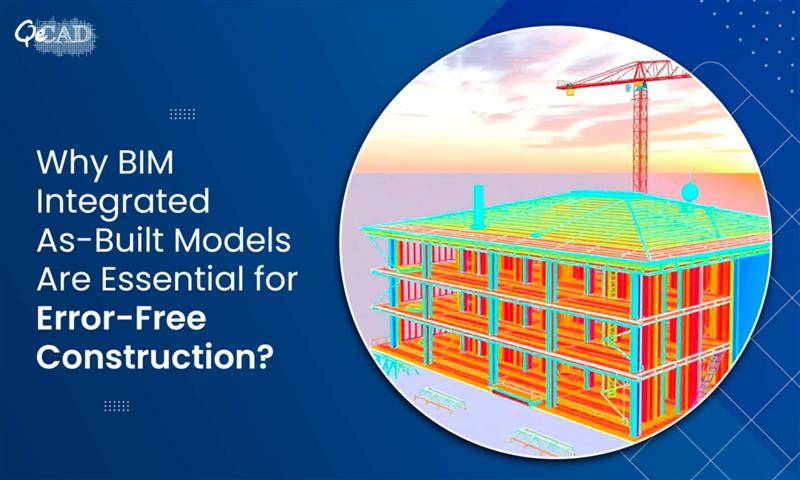
Construction projects are complex ecosystems involving the architects, engineers, contractors, fabricators and facility managers. Even with the advanced planning, discrepancies between the design intent and actual construction frequently occurs. These discrepancies, if not properly documented, can lead to operational inefficiencies, costly reworks and safety risks.
This is where BIM-integrated as-built modeling plays a critical role.
By capturing the true conditions of a completed structure, BIM-enabled as-built models provide accurate digital records that helps the project stakeholders to minimize errors, improve collaboration and ensure long-term asset reliability.
The Challenge of Construction Deviations
No construction project is executed exactly as originally designed. Changes occur due to:
- Site constraints
- Design revisions
- Material substitutions
- Contractor adjustments
- Coordination conflicts
According to the industry research from organizations like the Construction Industry Institute, reworks can account for nearly 5–10% of the total construction costs. In large projects, this can translate into major unnecessary project expenditures.
Without accurate documentation of field modifications, future renovations, the maintenance activities or facility upgrades become significantly more complicated.
What is BIM-Integrated As-Built Modeling?
BIM-integrated as-built modeling refers to the process of updating a Building Information Model to reflect the actual constructed conditions of a project.
Rather than relying solely on the redlined drawings or static documentation, BIM allows the teams to create a data-rich 3D digital twin of the completed structure.
This process typically involves:
- Collecting field data using laser scanning or site measurements
- Converting the point cloud data into BIM geometry
- Updating the models to reflect the real-world installations
- Integrating equipment specifications and asset data
- Validating the model accuracy with the site conditions
Organizations that specialize in As Built Modeling Services ensures that the final BIM model represents the structure exactly as it exists on site.
Why Accurate As-Built Documentation Matters?
- Reduces Construction Errors and Rework
Incomplete or outdated documentation often leads to coordination issues during later project phases. Accurate BIM as-built models helps the contractors and engineers to verify installed systems thus preventing costly clashes during renovations or retrofits.
Studies indicates that nearly 30% of the construction rework is caused by poor communication or inaccurate project data. Accurate as-built models significantly reduces this risk.
- Improves Facility Management and Operations
Facility managers relies heavily on the building documentation to maintain the building systems.
With BIM-integrated as-built models, teams can gain access to:
- Exact equipment locations
- Maintenance data and asset specifications
- System connectivity and routing
- Accurate spatial information
This enables faster troubleshooting and more efficient building operations.
- Supports Future Renovations and Expansions
Buildings rarely remains static. Over their lifecycle, most facilities undergo multiple renovations, upgrades and expansions.
Without reliable as-built documentation, project teams often spend weeks performing field verification before beginning any new design work.
A BIM-based as-built model eliminates this inefficiency by providing a trusted digital reference for future projects.
- Enhances Collaboration Across Stakeholders
Construction projects involves multiple stakeholders working with different tools and disciplines. BIM as-built models act as a centralized source of truth, enabling architects, engineers, contractors and facility teams to collaborate more effectively.
When everyone works from the same verified model, coordination becomes significantly smoother.
The Role of Technology in As-Built Modeling
Modern technologies have transformed the way as-built documentation is created.
Common technologies used includes:
- Laser scanning (LiDAR) for high-precision data capture
- Point cloud processing for accurate geometry reconstruction
- BIM platforms such as Revit for model development
- Cloud collaboration tools for data sharing
These technologies enables the teams to achieve millimeter-level accuracy thus ensuring that the digital models closely matches the physical structure.
Organizations providing the professional As Built Services combines these technologies with the structured BIM workflows to deliver the reliable project documentation.
Key Industries Benefiting from BIM As-Built Modeling
BIM as-built modeling is increasingly critical across several sectors, including:
- Healthcare facilities
- Airports and transportation infrastructure
- Commercial buildings
- Industrial plants
- Data centers
- Educational institutions
In sectors like healthcare and infrastructure, where the system coordination is extremely complex, accurate as-built models are essential for operational continuity.
Best Practices for Effective As-Built Modeling
To ensure the reliable outcomes, project teams should follow several best practices:
Capture field data early and consistently
Frequent scanning during the construction helps to track the design changes accurately.
Integrate as-built updates into the BIM workflow
Updating the model throughout the project lifecycle ensures accuracy.
Establish clear BIM standards
Defined modeling standards improves consistency across teams.
Use experienced BIM professionals
Technical expertise ensures that the model reflects the real-world conditions accurately.
Final Thoughts
As construction projects become more technologically advanced and data-driven, the importance of accurate post-construction documentation continues to grow.
BIM-integrated as-built modeling bridges the gap between the design intent and real-world construction thereby enabling the project teams to reduce errors, streamline operations and create long-term value for building owners.
Organizations that invest in the structured as-built workflows not only minimizes the construction risks but also lays the foundation for smarter facility management and future-ready infrastructure.