
In the AEC industry, a complete architectural drawing set is more than just a collection of plans—it is the backbone of the project execution. From concept validation to on-site construction, these drawings ensures that every stakeholder works with clarity, precision and coordination.
A well-structured drawing set minimizes the ambiguities, reduces RFIs and accelerates the approvals thus making it a critical component of effective Construction Documentation Services. Be it residential, industrial, commercial or infrastructural projects, the completeness of the drawing package directly impacts the project costs, timelines and quality.
- Cover Sheet & Drawing Index
The cover sheet acts as the project’s identity page and reference guide.
Key inclusions:
- Project name and location
- Client and consultant details
- Drawing index with sheet numbers
- Legend and abbreviations
- Applicable codes and standards
Why it matters:
A well-organized index improves the navigation across the drawings, especially in large projects with 100+ sheets.
- Site Plan
The site plan provides a top-down view of the entire project within its surrounding context.
Key inclusions:
- Property boundaries and setbacks
- Building footprint and orientation
- Access roads, parking and landscaping
- Utility connections (water, drainage, electrical)
- North direction and scale
Industry insight:
Errors in site planning can lead to the regulatory non-compliance and rework costs of up to 5–10% of the project value.
- Floor Plans
Floor plans are the most frequently referenced drawings during the construction.
Key inclusions:
- Room layouts and dimensions
- Wall thickness and material indications
- Doors and window locations with tags
- Furniture layout (optional but useful)
- Levels and floor finishes
Best practice:
Ensure the dimensioning clarity—missing or inconsistent dimensions are among the top causes of the site confusion.
- Elevations
Elevations depicts the building’s external appearance and vertical relationships.
Key inclusions:
- Exterior finishes and materials
- Heights and vertical dimensions
- Windows and door placements
- Façade treatments and design elements
Why it matters:
Elevation drawings are critical for client approvals and also ensures that the aesthetic intent is maintained during the execution.
- Sections
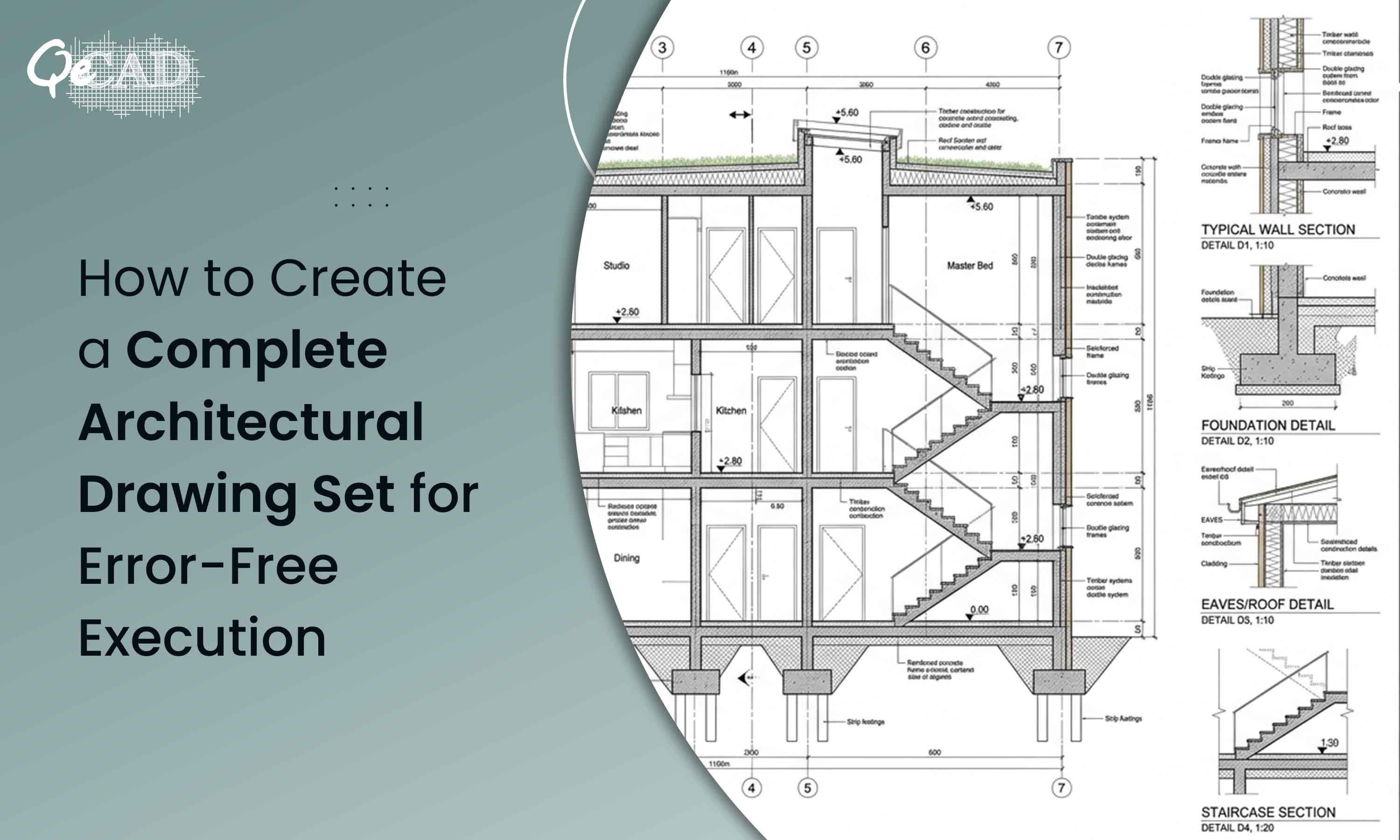
Sections cut through the building to reveal the internal construction details.
Key inclusions:
- Floor-to-floor heights
- Structural components (slabs, beams)
- Wall assemblies and insulation
- Staircases and vertical circulation
Technical advantage:
Sections helps to identify the clashes between the architectural and structural systems early in the design phase.
- Detailed Drawings (Enlarged Plans)
These drawings zoom into the critical areas for clarity.
Examples:
- Toilet and kitchen layouts
- Staircase details
- Joinery and millwork drawings
- Wall sections and façade details
Why they matter:
Detailed drawings reduces the on-site assumptions thus improving the workmanship quality and reducing the reworks.
- Door and Window Schedules
Schedules provide tabulated information for repetitive elements.
Key inclusions:
- Door/window types and sizes
- Material specifications
- Hardware details
- Fire ratings (if applicable)
Efficiency insight:
Standardized schedules can reduce the documentation time by up to 20% in the large projects.
- Reflected Ceiling Plans (RCP)
RCPs show ceiling layouts and coordination with the MEP systems.
Key inclusions:
- Ceiling heights and levels
- Lighting fixture layouts
- HVAC diffusers and vents
- Ceiling materials and patterns
Coordination benefit:
RCPs play a key role in avoiding clashes between the architectural and MEP services.
- Finishes Schedule
This document specifies the material finishes across the project.
Key inclusions:
- Flooring, wall and ceiling finishes
- Paint types and codes
- Texture and material references
- Room-wise finish mapping
Why it matters:
A clear finishes schedule ensures the consistency in design intent and procurement accuracy.
- General Notes & Specifications
General notes defines the project-wide standards and instructions.
Key inclusions:
- Material specifications
- Construction guidelines
- Safety and compliance notes
- Reference standards
Best practice:
These notes act as a contractual reference thus reducing the disputes during the construction.
- Coordination Drawings
While primarily associated with BIM, the coordination drawings are increasingly a part of architectural sets.
Key inclusions:
- Integration with structural and MEP systems
- Clash-free layouts
- Space allocation for services
Industry statistic:
Projects with coordinated drawings can minimize the change orders by up to 30%.
- As-Built Drawing Provisions (Optional but Critical)
Although created post-construction, provisions for as-built updates should be included.
Why it matters:
Accurate as-built documentation supports the facility management and future renovations.
The Role of a Complete Drawing Set in Project Success
A comprehensive architectural drawing set is not just about the compliance—it is about efficiency, coordination and risk mitigation. Incomplete or poorly structured drawings often leads to:
- Increased RFIs and delays
- Cost overruns due to reworks
- Misinterpretation by the contractors
- Coordination failures across disciplines
This is where the professional Architectural Drawing Services adds significant value by ensuring accuracy, standardization and seamless integration with multidisciplinary workflows.
Conclusion
A complete architectural drawing set serves as the single source of truth for all stakeholders involved in a construction project. It bridges the gap between the design intent and on-site execution thus ensuring that every detail is communicated with precision.
As projects becomes more complex and timelines more compressed, the importance of well-structured construction documentation continues to grow. Investing in a comprehensive drawing set is not just a design necessity—it is a strategic decision that directly impacts the project success, cost control and long-term performance.